



31 Dec2012
Tamopan Persimmons at Rose-Lovell
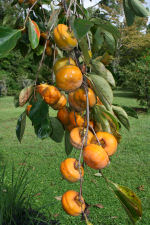 The Rose-Lovell House had such a full crop of persimmons this year that the tree was “self pruning”. Yep, branches were breaking under the load.
These are Tamopan (or Japanese) persimmons. They are of the astringent variety which means if you eat them before they are ripe then your mouth would be squeezed in to a pucker for a week!
But ripe they are the sweetest thing you’ve ever tasted. Trouble is that they only stay that way for about 10 minutes. When they get extremely soft you overturn the fruit, peel from the bottom and scoop it with a spoon. The edible thick skin will act as a bowl to hold the soft sweet fruit inside.
Origin and Distribution
The tree is native to Japan, China, Burma and the Himalayas and Khasi Hills of northern India. In China it is found wild at altitudes up to 6,000-8,000 ft and it is cultivated from Manchuria southward to Kwangtung. Early in the 14th Century, Marco Polo recorded the Chinese trade in persimmons. Korea has long-established ceremonies that feature the persimmon. Culture in India began in the Nilgiris. The tree has been grown for a long time in North Vietnam, in the mountains of Indonesia above 3,500 ft and in the Philippines. It was introduced into Queensland, Australia, about 1885.
It has been cultivated on the Mediterranean coast of France, Italy, and other European countries, and in southern Russia and Algeria for more than a century. The first trees were introduced into Palestine in 1912 and others were later brought in from Sicily and America.
Seeds first reached the United States in 1856 when they were sent from Japan by Commodore Perry. Grafted trees were imported in 1870 by the U.S. Department of Agriculture and distributed to California and the southern states. Other importations were made by private interests until 1919. Seeds, cuttings, budwood and live trees of numerous types were brought into the United States at various times from 1911 to 1923 by government plant explorers and the tree has been found best adapted to central and southern California, Arizona, Texas, Louisiana, Mississippi, Georgia, Alabama, southeastern Virginia, and northern Florida.
The Rose-Lovell House had such a full crop of persimmons this year that the tree was “self pruning”. Yep, branches were breaking under the load.
These are Tamopan (or Japanese) persimmons. They are of the astringent variety which means if you eat them before they are ripe then your mouth would be squeezed in to a pucker for a week!
But ripe they are the sweetest thing you’ve ever tasted. Trouble is that they only stay that way for about 10 minutes. When they get extremely soft you overturn the fruit, peel from the bottom and scoop it with a spoon. The edible thick skin will act as a bowl to hold the soft sweet fruit inside.
Origin and Distribution
The tree is native to Japan, China, Burma and the Himalayas and Khasi Hills of northern India. In China it is found wild at altitudes up to 6,000-8,000 ft and it is cultivated from Manchuria southward to Kwangtung. Early in the 14th Century, Marco Polo recorded the Chinese trade in persimmons. Korea has long-established ceremonies that feature the persimmon. Culture in India began in the Nilgiris. The tree has been grown for a long time in North Vietnam, in the mountains of Indonesia above 3,500 ft and in the Philippines. It was introduced into Queensland, Australia, about 1885.
It has been cultivated on the Mediterranean coast of France, Italy, and other European countries, and in southern Russia and Algeria for more than a century. The first trees were introduced into Palestine in 1912 and others were later brought in from Sicily and America.
Seeds first reached the United States in 1856 when they were sent from Japan by Commodore Perry. Grafted trees were imported in 1870 by the U.S. Department of Agriculture and distributed to California and the southern states. Other importations were made by private interests until 1919. Seeds, cuttings, budwood and live trees of numerous types were brought into the United States at various times from 1911 to 1923 by government plant explorers and the tree has been found best adapted to central and southern California, Arizona, Texas, Louisiana, Mississippi, Georgia, Alabama, southeastern Virginia, and northern Florida.
Tags: rose-lovell fruit trees
Trackback from your site.